Society / Analysis
Taiwan’s baby bust · Forum watch
Taiwan’s birth rate is heading toward 0.5. Why does nobody seem to care?
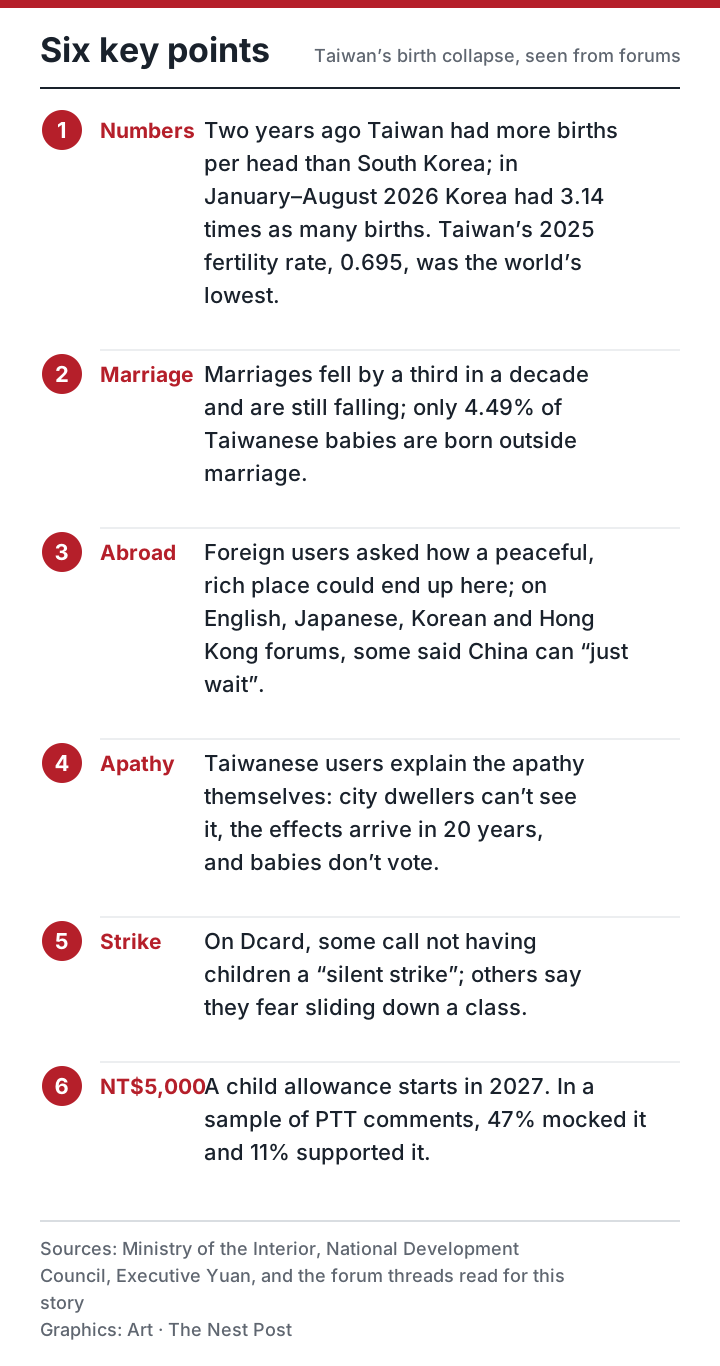
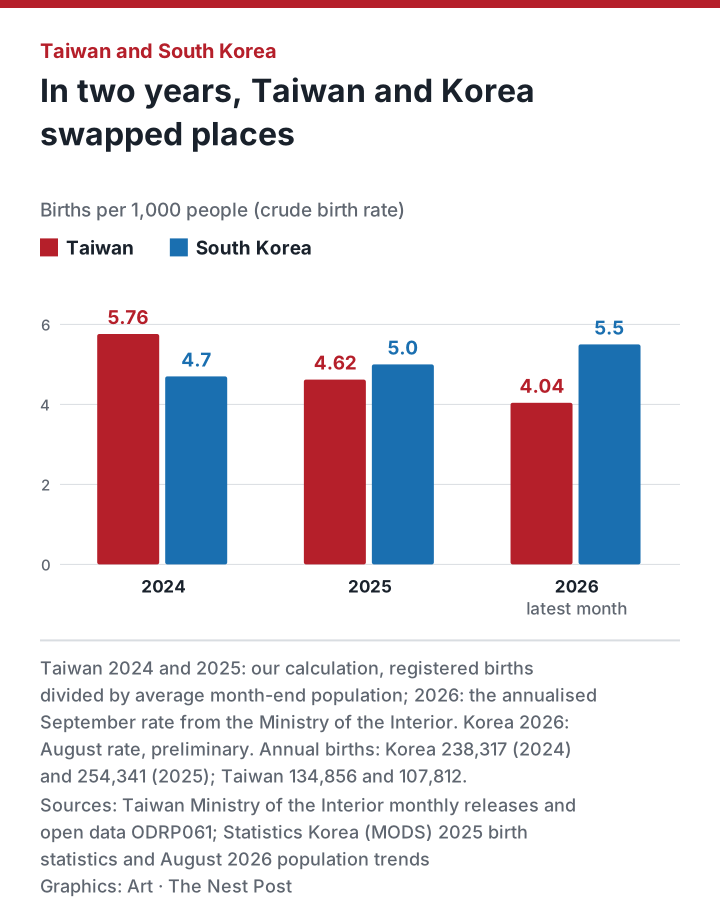
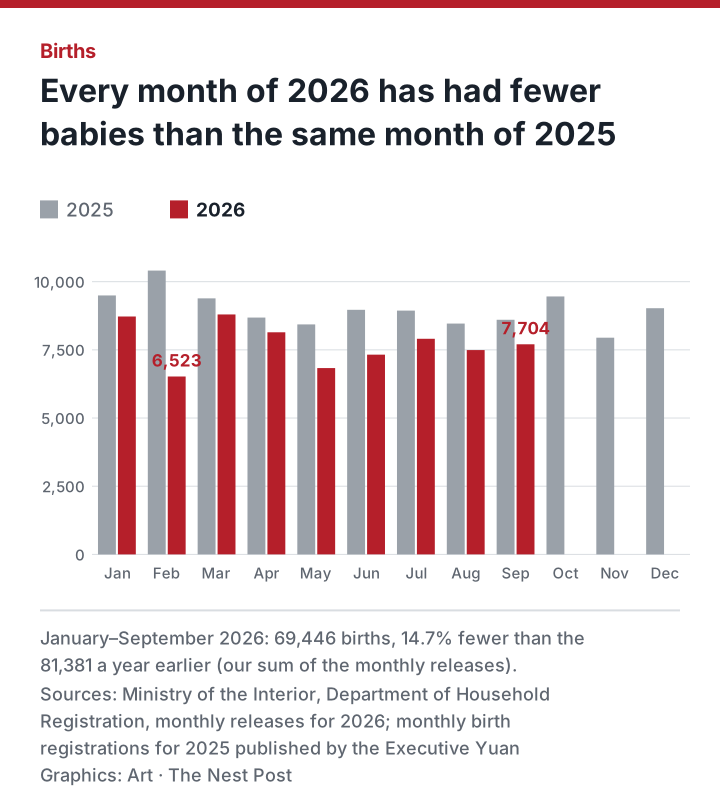
Two years ago, Taiwan had almost six births a year for every 1,000 people. South Korea, then the country with the world’s lowest birth rate, had fewer than five. This year the two have swapped places: in September, Taiwan’s births worked out at 4.04 per 1,000 people a year; in August, Korea’s were 5.5. From January to August 2026, Korea recorded 3.14 times as many babies as Taiwan, an island of 23 million people off the coast of China. This is not a slow decline. From 2015 to 2024 Taiwan’s births fell by about 5% a year; in 2025 they fell by a fifth, and in the first nine months of 2026 by another 14.7%. Fewer people are marrying, too, and in Taiwan almost every child is born within marriage. Online, the reaction was mostly sarcasm. On 10 March, after the Ministry of the Interior reported 6,523 births in February, 37% fewer than a year earlier, a post on PTT, the island’s oldest and busiest forum, drew 1,130 replies in a day. One joke recurred again and again: “birth decline, great success.” Foreign users asked a different question: how could this happen in a peaceful country with a growing economy? We read about 150 discussion threads and more than 35,000 comments posted between January and October 2026, on forums inside and outside Taiwan, and re-added the ministry’s raw statistics, to answer a question foreign users kept asking: if Taiwan’s birth rate is heading toward 0.5, why does nobody there seem to care?
In this story
- Overtaken by South Korea in two years
- No marriage, no baby
- Abroad, a security story; at home, a personal one
- “A peaceful country with a growing economy”: how the world diagnosed Taiwan
- “Nobody gives a shit”: why the alarm doesn’t land
- A “silent strike”: what people who won’t have children say
- Will NT$5,000 a month buy a baby?
- The line to watch in 2027
Overtaken by South Korea in two years
Start with the neighbour. South Korea was for years the country with the world’s lowest birth rate. According to Statistics Korea, the country recorded 4.7 births per 1,000 people in 2024 and 5.0 in 2025, when its total fertility rate recovered to 0.80. In August 2026 the annualised rate was 5.5, and births in January–August were 193,783, up 14.5% on a year earlier.
Taiwan went the other way. Dividing registered births by the average month-end population in the Ministry of the Interior’s open data, we find Taiwan had about 5.76 births per 1,000 people in 2024, more than Korea, and about 4.62 in 2025, fewer than Korea. By September 2026 the ministry’s annualised crude birth rate was 4.04 per 1,000. In absolute numbers, Korea recorded 1.77 times as many births as Taiwan in 2024 and 2.36 times as many in 2025; in January–August 2026 the figures were 193,783 against 61,742, or 3.14 times. Taiwan had taken over the title of “world’s lowest”, and that is where foreign forum discussions of Taiwan began.
Start with the official figures. Taiwan registered 107,812 births in 2025, a fifth fewer than the 134,856 of 2024. In its August population projection, the National Development Council (NDC), the government’s planning agency, said the total fertility rate had fallen to 0.695 in 2025, from 0.885 the year before. The total fertility rate is the average number of children a woman would have in her lifetime; a population needs about 2.1 to replace itself.
Nor is this a slow decline. Adding up the ministry’s registration statistics, Taiwan recorded 213,598 births in 2015 and 134,856 in 2024, an average fall of about 5% a year over nine years. Then, in 2025 alone, births fell by a fifth.
The fall has not stopped this year. February’s 6,523 births were, in the ministry’s words, 37.32% fewer than a year earlier; May dipped to 6,832. In September Taiwan recorded 7,704 births, down 10.45%, and the population stood at 23,213,251, with more than one in five people aged 65 or older. Adding up the ministry’s monthly releases, Taiwan recorded 69,446 births from January to September, 14.7% fewer than the 81,381 a year earlier.
Where are the missing babies? By date of birth, the ministry’s figures show that births to mothers aged 25–29 fell 25.7% in 2025, to mothers aged 20–24 by 22.4%, 30–34 by 22.1% and 35–39 by 18.1%. Second births fell 24.4%, more than first births (19.7%). The steepest falls were among mothers in their twenties and among families who already had one child and did not have a second.
The mother’s nationality matters too. In January–September 2026, according to our sum of the ministry’s open data, births to foreign-national mothers were down only 3.8% on a year earlier, against 15.1% for Taiwanese mothers and 18.2% for mothers from mainland China, Hong Kong or Macau.
No marriage, no baby
Behind births are marriages. In 2015, 154,346 couples registered a marriage in Taiwan; in 2025, 104,376 did, a third fewer, and 15.2% fewer than in 2024 alone. In January–September 2026 there were 68,615 marriages, 7.6% fewer than a year earlier.
In Taiwan, the number of marriages is close to a ceiling on the number of births. According to the interior ministry’s statistics department, only 4.49% of babies born in 2025 were born outside marriage, and the share has stayed between 3.2% and 4.5% since 1998. Across OECD countries, 43% of births occur outside marriage on average (2023).
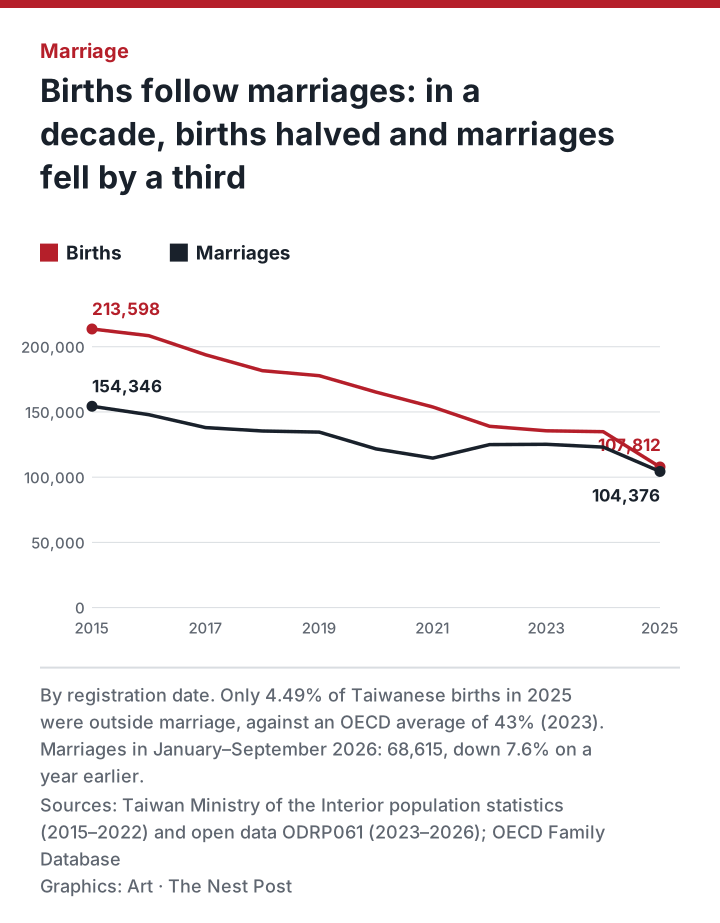
AnalysisMarriage usually comes one or two years before a first child. Because marriages are still falling this year, we infer that births will probably not have stopped falling when the child allowance starts in 2027. This is an inference from the past relationship, not an official projection; the NDC’s own central projection also assumes fewer births in 2026 than in 2025.
The “0.59” and “almost 0.5” figures circulating online are users’ own extrapolations. The NDC estimates 92,000–97,000 births and a fertility rate of 0.62–0.66 in 2026, with a central estimate of 0.64. The gap comes from method: cutting last year’s rate by the fall in births gives about 0.59, but the number of women aged 20–49 has been shrinking since 2005, so the rate per woman falls more slowly than the number of babies.
Some numbers have been exaggerated. In April, media reports said Taiwan’s population would halve by around 2065; the NDC replied that this was not information it had published. Its official projection, released in August, has the population falling to 19.98 million by 2045 and 12.15 million by 2075, when more than half of Taiwanese would be over 65.
Abroad, a security story; at home, a personal one
Mainstream media framed the story very differently from the forums. Agence France-Presse led in January with Taiwan becoming a “super-aged society”. China’s state news agency Xinhua reported the population’s 30th straight monthly decline in July in flat statistical terms, without commentary on cross-strait relations. Singapore’s Lianhe Zaobao ran a feature in August on young people refusing to pay the price of raising children: housing, wages, care.
Korean media fixated on the ranking. MBC’s April report led with Taiwan’s 0.695, below Korea. Yonhap reported Taiwan’s premier wanting to raise the birth rate “like Korea”, and in September linked the shrinking population to defence, asking whether Taiwan could respond properly to a Chinese invasion. Newsweek found a memorable statistic: Taiwan had about 3.2 million pet cats and dogs and only 2.68 million children aged 14 and under.
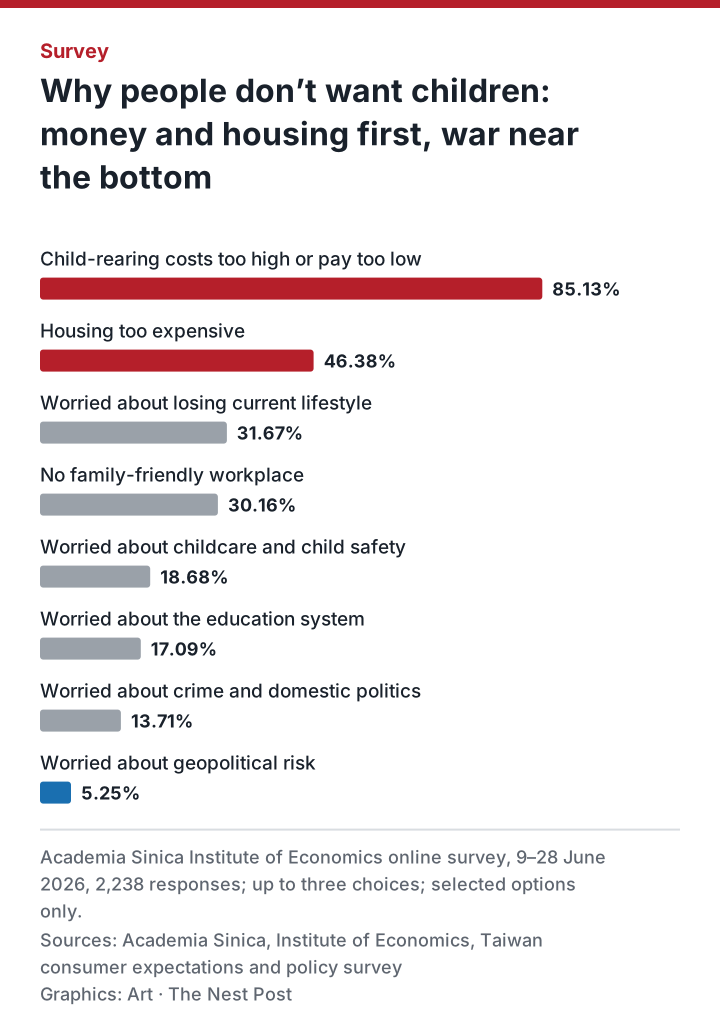
Those frames — ageing, national security, pets outnumbering children — recur on foreign forums. On Taiwan’s own forums, security is rarely the reason people give for not having children. A June survey by Academia Sinica, Taiwan’s national research academy, asked people why they did not want children. The top answer was child-rearing costs too high or pay too low (85.13%), followed by housing prices (46.38%). Only 5.25% named geopolitical risk.
“A peaceful country with a growing economy”: how the world diagnosed Taiwan
On English-language Reddit, the first reaction was usually disbelief. After the February figures, a user on r/taiwan wrote:
This is an apocalyptic level of decline in a peaceful country with a growing economy.
Japanese users on 5ch, Japan’s largest anonymous message board, asked the same question with more bite. In July, someone on its NanJ board started a thread saying Taiwan’s birth rate had hit the lowest “in human history”; one reply asked why, when TSMC is raking it in, and the next answered that only people connected to TSMC make money from TSMC. Another aggregator site kept a sharper comment:
正直東アジアは全部日本の劣化コピーなんやなって
Honestly, all of East Asia is just a degraded copy of Japan.
In a September thread on the board VIPPER, someone asked whether a good economy wasn’t supposed to fix low birth rates; the original poster added that China would not even need to attack, because Taiwan would die out on its own. That idea — China wins by waiting — appeared on English, Japanese, Korean and Hong Kong forums alike:
Wait, so Beijing doesn’t even need to invade. They can just wait.
중국이 그냥 기다리면 통일되겠네
China will get unification just by waiting.
中國表示: do nothing, win
China says: do nothing, win.
On r/Natalism, a pro-birth community, the argument went further: one user said the United States would not send its servicemen to die for a country about to collapse. Others pushed back that telling Taiwanese to have children so they can serve as “human shields” against China would convince nobody.
Korean reactions were the most mixed. When the news broke in January, the first response on the Damoang forum was astonishment:
이야... 이걸 이겨요? ㄷㄷㄷㄷ
Wow… they beat us at this? Yikes.
Others borrowed the two countries’ self-mocking nicknames — “Hell Joseon vs Ghost Island” — or warned that Korea had been the overwhelming last-place country for years and had turned around only once. On English Reddit, a self-described Korean offered “heartfelt congratulations” to Taiwan for taking over the “championship”, while an r/korea user wrote: “Taiwan, we’re in this together”.
Hong Kong and mainland users mostly compared Taiwan with themselves. On LIHKG, Hong Kong’s main forum, early replies included “Hong Kong actually lost” and “Taiwan really is the most advanced in the class”. One user defended Taiwanese women:
我台灣朋友話職場會歧視大肚婆,搵方法趕走佢 邊個敢有bb?
My Taiwanese friend says workplaces discriminate against pregnant women and find ways to push them out — who would dare have a baby?
The same thread also had many posts blaming feminism in derogatory terms, which we do not quote. On Zhihu, a mainland Chinese Q&A site, an April post cited the 0.695 figure; commenters, whose provinces were shown by IP, said a small island of 23 million was crowded anyway, joked that China’s low-fertility northeast and Jiangsu province “are not alone after all”, and suggested bringing in mainland immigrants. The same post repeated the 2065 halving claim that the NDC had disowned.
AnalysisHow did Taiwanese react to these outside diagnoses? PTT’s Gossiping board ran at least three threads this year translating foreign comments, from Reddit, Korea and Japan. Few replies hit back at the foreigners; more used them against Taiwan’s own government — “foreigners see it more clearly than Taiwan’s politicians”, or “what did the Korean get wrong?” Only in the Japanese thread did someone object that the Japanese have no idea how absurd our housing prices are.
“Nobody gives a shit”: why the alarm doesn’t land
In August a post on r/Natalism put the question bluntly:
Welcome to Taiwan where TFR is on the verge of dropping into the 0.5 range, but nobody gives a shit.
The same user asked again on r/NoStupidQuestions the next day: Taiwan is geopolitically vital, so why is nobody interested? The bluntest answer came from a non-Taiwanese user:
the demographic crisis of Taiwan is really only of importance to Taiwanese people
Others asked the poster whether Taiwanese counted as “nobody”. People living in Taiwan described fatigue instead. Under an r/taiwan post asking whether births falling below 90,000 would shock the country, one user replied that something talked about to death just becomes repetitive news. Another listed what Taiwanese worry about more: unaffordable housing, low pay, and China’s threats.
Mainland users noticed too. Under the Zhihu post, a user from Fujian wrote that the Taiwanese themselves don’t care, and that young people mostly blame housing. A user whose IP location read “Taiwan, China” — Zhihu’s label — replied in traditional characters:
沒事 房價還在漲
No worries, house prices are still going up.
How do Taiwanese explain the apathy themselves? We read 86 PTT threads on the birth rate from this year, about 30,000 replies, and found five recurring answers. The first is the city–countryside gap. A June thread asking why a shrinking population doesn’t feel real drew 851 replies; the most common answer was “because you live in a city”:
都市無感 但路上小孩明顯變少了
You can’t feel it in the city, but there are clearly fewer kids on the streets.
The second is that the population hasn’t shrunk much — the children have. One reply asked “Is what you feel the number of people, or the number of children?” A long Dcard post explained that the total still sits at 23 million because the large generations born decades ago are still alive: people aged 45–49 outnumber children under five by 2.9 to one, and while the resident citizen population falls by about 100,000 a year, the foreign resident population is growing by about 98,000. The third is delay: the effects will be felt in 20 or 30 years.
The fourth answer appeared independently on several boards, and was the most consistent: babies can’t vote. Under a September thread asking why nobody seems to want to fix the problem, one user wrote:
嬰兒沒有投票權 黨等不了20年 只想現在能
Babies don’t have votes. The party can’t wait 20 years; it only wants what it can get now.
A parent on the BabyMother board asked the same thing — “Children don’t have votes, so they don’t matter?” — and the stock-market board put it in an investor’s voice: “Nobody cares; the low birth rate has finally succeeded.” The fifth answer is that the sarcasm is a cover for helplessness. In July someone asked why most people seem glad about the decline. A reply:
與其說樂見不如說無能為力的自我諷刺吧
It’s less that people are glad and more a kind of self-mockery out of helplessness.
AnalysisBack in the February thread, jokes like “great success” and “come on, target under 5,000” filled the page; between them was “Seriously, this is terrifying, the country will die out”. From outside it looks like indifference. From inside, the sneer is itself a reaction. In June a user asked why the Gossiping board is so obsessed with the birth rate — every monthly release produces a thread of more than a thousand replies. “Nobody cares” is not quite right. A better description: the people who care do not believe saying so will change anything.
A “silent strike”: what people who won’t have children say
Beyond the sarcasm, some users set out their reasons in earnest. In January a Dcard user who goes by “Tainan person” wrote that they finally understood: “we are on a silent strike”. The issue, they argued, was not affording food but the fear of “class downgrade”: a dual-income couple who travel abroad and eat out on weekends can, with a child and a mortgage, become the “busy poor” who dare not quit, get sick or spend.
所以政府別再問為什麼發錢沒用了。
So the government should stop asking why handing out money doesn’t work.
One of the most-liked replies came from a parent who said the family owned two homes and a rental flat and still “only dared to have one”; what they wanted was not small subsidies but safety — traffic, bullying, abuse. They added: “A strike that only gets you to 0.87 — how ironic.”
After the February figures came out in March, a Dcard user posted “Congratulations!”, urging others to “keep going and never have kids”. A sadder reply the next day said that rather than bleed in street protests, people had chosen the silent protest of “not having children”:
不讓下一個生命降生在這個不值得的社會,或許是我們最後的溫柔。
Not letting another life be born into a society that doesn’t deserve it may be our last act of tenderness.
A Taiwanese user later translated that post into English for r/Natalism. Readers split: one had never heard of low birth rates as a collective silent protest and wanted to think about it; another said there was “not a single bit of protest” in it, only young people putting their comfort first. On PTT, a June thread called the decline a “womb revolution” — but its author meant it as a warning:
子宮革命結束後,所有文化、語言、基因、習俗都會被替換與滅絕。
When the womb revolution is over, every culture, language, gene and custom will have been replaced and wiped out.
Many replies cheered instead — “not having kids really is this era’s revolution” — while others rejected the author’s idea that everyone loses: “only the people at the bottom lose, twice.”
The concrete pain points are clearest on Dcard and PTT’s parenting boards. A March Dcard post listing eight reasons why Taiwanese women don’t want children, from housing to working hours, drew a top reply with 750 likes: Taiwanese men don’t want children either. In September a Dcard user asked how dual-income families with no grandparents nearby are supposed to manage. A father replied that his wife was in hospital, his child had to be at school by 7:40 a.m., and his boss moved the morning meeting online to 7:30:
他回「你半路停下來開會啊」。
He replied: “Just pull over and join the meeting.”
When a young engineer asked him whether raising a child was hard, he said, “in Taiwan, never have children, the environment just doesn’t allow it”. On PTT’s BabyMother board, a mother wrote that before she gave birth her manager told her outright that taking parental leave would mean a different job when she came back — “I hadn’t even said I would take it”.
AnalysisThese are not the only voices. In February PTT’s marriage board asked: if you could choose again, would you still marry and have children? Of about 70 replies we read, about 26 said yes, 10 said no and 8 would do only one of the two. Those who said yes wrote about the rewards: “When I get home from work and my kid runs over to hug me, it’s worth it however tired I am.” Those who said no cited the way poverty passes down the generations. A Hong Konger married to a Taiwanese wrote on r/HongKong that most of his Taiwanese friends had no children, and it isn’t really about money but about not wanting to give up a child-free life.
Will NT$5,000 a month buy a baby?
The government’s answer took shape in May. On 20 May President Lai Ching-te announced a growth allowance of NT$5,000 a month for every child aged 0 to 18. A week later he unveiled 18 measures under a “new population strategy”; from age six to 18, half the allowance goes to the family and half into a savings account for the child. The Executive Yuan, Taiwan’s cabinet, said the new measures would take full effect next year, at an estimated NT$380 billion a year. The 2027 budget approved by the cabinet in August allocates NT$373 billion, including NT$185.3 billion for the allowance.
Abroad, the allowance was converted into about US$150 a month, and the reaction on r/whoathatsinteresting was mostly derision:
For the hell a woman will go through they best they can offer is a snack haul worth of money?
A self-described Taiwanese commenter said US$150 a month doesn’t do much to make raising a child affordable. A Pole said Poland pays about €180 a month and it “didn’t do shit”.
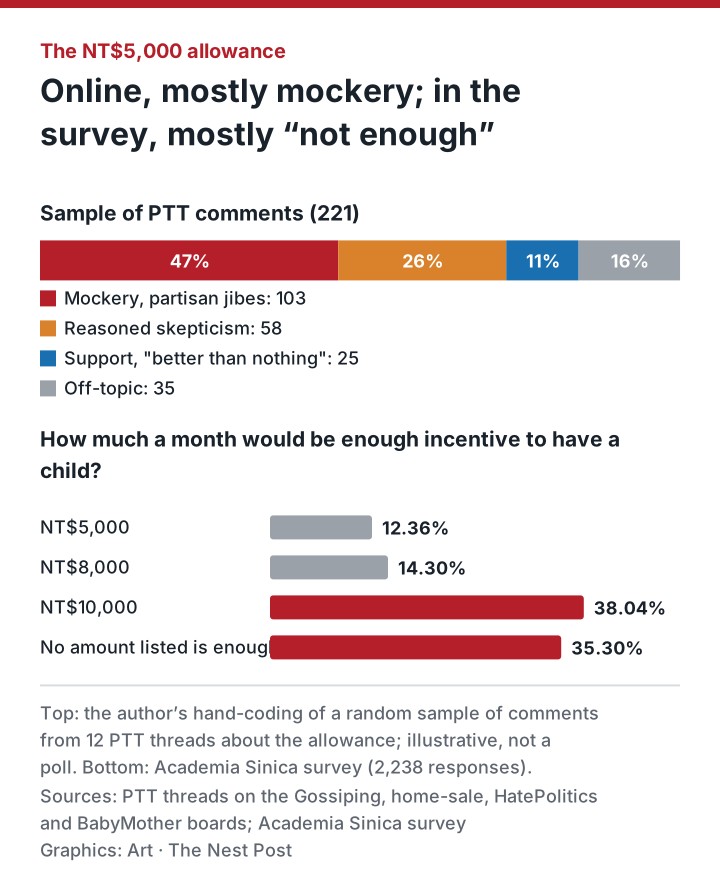
AnalysisPTT was more cutting still. We drew a random sample of 221 replies from 12 threads about the allowance and coded each by hand: 47% mockery or partisan jibes, 26% skepticism with a stated reason, 11% support, 16% off-topic. Typical mockery: “keep throwing money, keep drawing pies in the sky, keep breaking promises”. Typical skepticism: “How about I give you 5,000 and you raise my kid to 18?” Nearly all the support came from the home-sale board, for reasons unrelated to babies:
每個月多五千繳房貸,房價穩噴了!有孩家庭買房需求來臨!
An extra 5,000 a month for the mortgage — house prices are sure to soar! Here comes demand from families with kids!
Parents were the most specific. A BabyMother post in August observed that the more subsidies there are, the higher prices go; replies said kindergartens raised fees in step. In October a married Dcard user complained that her in-laws had offered NT$300,000 per child if the couple would have one; these days, she wrote, that won’t buy a single ping (about 3.3 square metres) of an old flat.
Research points the same way, though the headlines oversimplified it. In July, media reports on the Academia Sinica survey said 35% of respondents would not have children even with a NT$10,000 monthly allowance. The survey page itself shows 35.30% chose “none of these amounts would be enough incentive”, and only 12.36% said NT$5,000 would be enough — a judgment about the amount, not a pledge never to have children. In May the Legislative Yuan’s Budget Center found that cash such as child allowances and childcare subsidies made up 80–90% of family-support spending. The Taipei Times editorialised: “Cash alone cannot raise birthrates.”
Beyond money, one rule has changed this year. Since January, parents can take parental leave by the day. The labour ministry said in August that men made up more than half of day-based applicants for three months running, reaching 51.9% in July; over January–July, 9,132 men and 9,341 women applied this way. By contrast, of the 91,929 first payments of the traditional parental-leave allowance in 2025, only 25,376 went to men, about 27.6%.
Korea is the counterexample everyone reaches for. In April the premier said Taiwan should learn from Korea. Under a Dcard post tallying this year’s births, the most-liked reply said Korea had pushed its rate from 0.7 to above 0.9 and “the homework is right there to copy”. Koreans offer other explanations: an r/korea user said having babies is simply “in” now; a Damoang user credited President Lee Jae-myung. It is too early to say who is right.
The line to watch in 2027
In September a school administrator on Dcard lined up Taiwan’s January–August births for five years: 90,001, 88,935, 85,941, 72,778, 61,742. The government’s real competitor, the post argued, might not be the price of formula:
「不生的人生,現在其實很好過。」
“A life without children is actually pretty good these days.”
What the poster most wanted to see was simple: whether births stop falling in 2027 and 2028, once the allowance starts. If the line goes up, the birth-rate problem is easing; if it keeps falling, families with children are simply a little better off. The post ended: “In the end, the number of births doesn’t lie.”
The NDC’s central projection assumes the fertility rate will creep back up from 0.64 this year to 0.8 by 2075. Foreign users are waiting to see whether Taiwan can hold on; Taiwanese users are waiting to see whether the government is serious. October’s birth figures come out in early November, and on PTT there will probably be another thread with a thousand replies.
Subscribe to the newsletter from The Nest Post
One email each time an in-depth story is published, with the key points and any corrections. No advertising; unsubscribe at any time.